4 November 2026 · 20 min read
Wedding Dress Inspiration: Bridal Gown Ideas for Every Style
Romantic, modern, statement and floral wedding dresses, and how to choose one you can wear all day.
Finding your dream wedding dress
A wedding dress has to agree with three things at once: the person wearing it, the place, and the way you want the photographs to feel when you look at them again. A garden at four o'clock and a candlelit ballroom ask for different cloth, different trains and different shoes, even when both brides would call their taste romantic. The gown also has to survive sitting, eating, a flight of stairs and a long hug. A beautiful portrait that required you to hold your breath is a short-lived victory.
The photographs here are bridal gown inspiration, sorted by the idea each dress is built around. They are references for silhouette, colour and wedding gown details, with no designer and no price attached. Use them to see how a neckline, a sleeve or a single flower changes the wedding a gown belongs to. If you are choosing what to wear as a guest, start with the wedding guest dress codes. Prom, party and formal dresses live in a separate guide to dresses and gowns for special occasions. This page is for the bride.
Wedding dress ideas for modern brides usually begin with a feeling and then have to pass a practical test. You might want something artistic, or something so quiet the room does the decorating, or a skirt that fills a staircase. Hold that feeling up against the venue, the season and the number of hours you will be dressed. The dream wedding dress is the one that still feels like yours after the portraits are finished.
Wedding dress inspirations
Wedding dress styles are easier to compare once you sort them by the decision they ask you to make. Romantic gowns put lace, pearls or a full satin skirt at the centre. Modern bridal gowns keep the line quiet and spend their one detail on a sleeve, a peplum or a drape. Statement dresses bet the photograph on volume or a single architectural shape. Floral gowns borrow a petal, a rose or a trail of embroidery. One gown in this set takes the floral idea further, into the shape of a tulip, and it has a section of its own.
Romantic and timeless wedding dresses
Elegant wedding dresses in this group rely on satin, lace and pearls, and on silhouettes people already recognise as bridal: the mermaid, the A-line, the ball gown. The romance is in the surface and the fullness. The timeless part is that the ornament stays in one place, usually the neckline or the hip, so the skirt can read clearly from across a room.
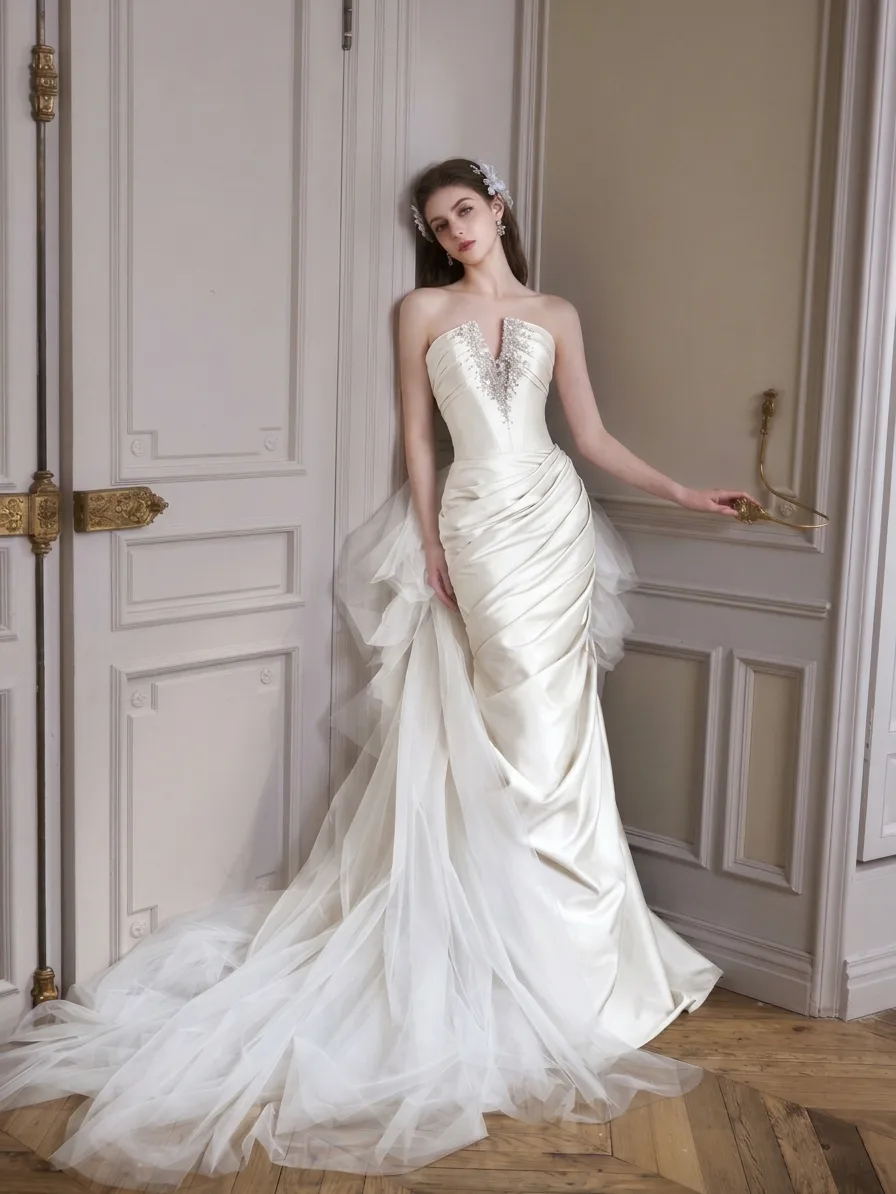
Ivory satin mermaid with a crystal plunge
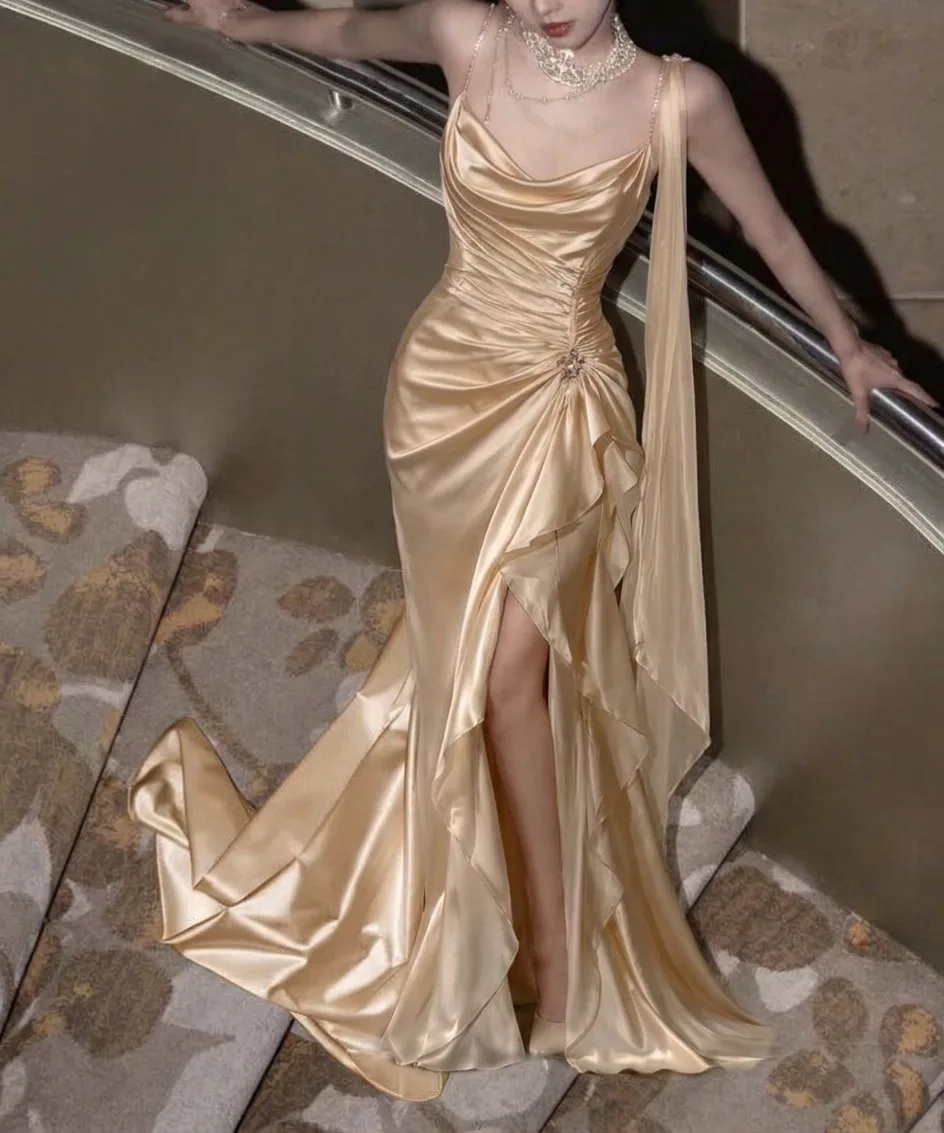
A strapless ivory mermaid, a deep neckline lined with crystals, ruching through the hip, and a fall of tulle from one side into a long train. This belongs in a room with moulding, stairs or candlelight, where the satin catches a warm bulb and the tulle gives the photograph its width. The crystals are the jewellery. In the portrait the earrings stay small and a flower sits at the temple, which keeps the neckline as the bright point. Satin creases across the lap, so sit in it on a hard chair before you decide. A mermaid also shortens your step on stairs. If the tulle is caught at the hip, you will want a plan for gathering it when you turn to walk back down the aisle.
- Silhouette
- Mermaid, with tulle from the hip
- Best room
- Indoor ceremony, evening light, a staircase
- Jewellery
- Studs. The crystal neckline is the piece.
- Test
- Sitting, stairs, and turning with the tulle
Why it works — Satin gives the fitted line, and the tulle gives the train, so the dress is formal in a portrait and still has movement.
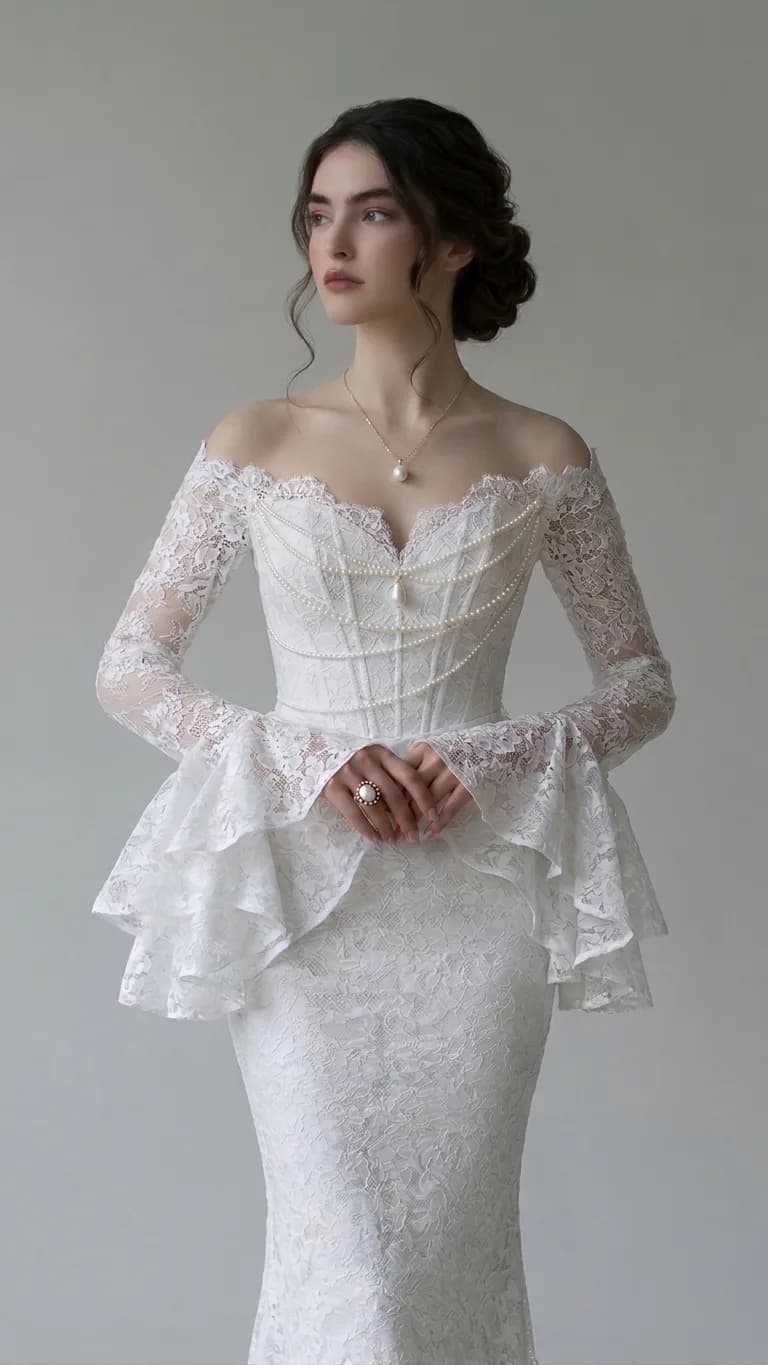
Lace off-the-shoulder gown with pearl swags
Off-the-shoulder lace, a sweetheart neckline, strands of pearls draped across the bodice, flared lace cuffs and a flounce over a fitted lace skirt. Romantic wedding dresses often mean lace and pearls together, and here both sit where the eye lands first. The pearl swags are the necklace. A single pendant in the open neckline, as in the photograph, is the scale that works. A choker stacked on the swags would be a second necklace. The flared cuffs cover the wrist, so a bracelet has nowhere to show. Lace is a good cloth for a church or a hotel wedding because texture reads in photographs where plain shine can blow out. Look at the lining in daylight. Lace over a warm lining and lace over a cool one are different dresses once you leave the fitting room.
- Surface
- Lace, with pearl swags on the bodice
- Neckline
- Off the shoulder, with flared cuffs
- Jewellery
- One pendant in the neckline, or nothing
- Check
- The lining colour in the light of your venue
Why it works — The pearls and the lace are concentrated on the bodice, so the skirt can stay a clean fitted line.
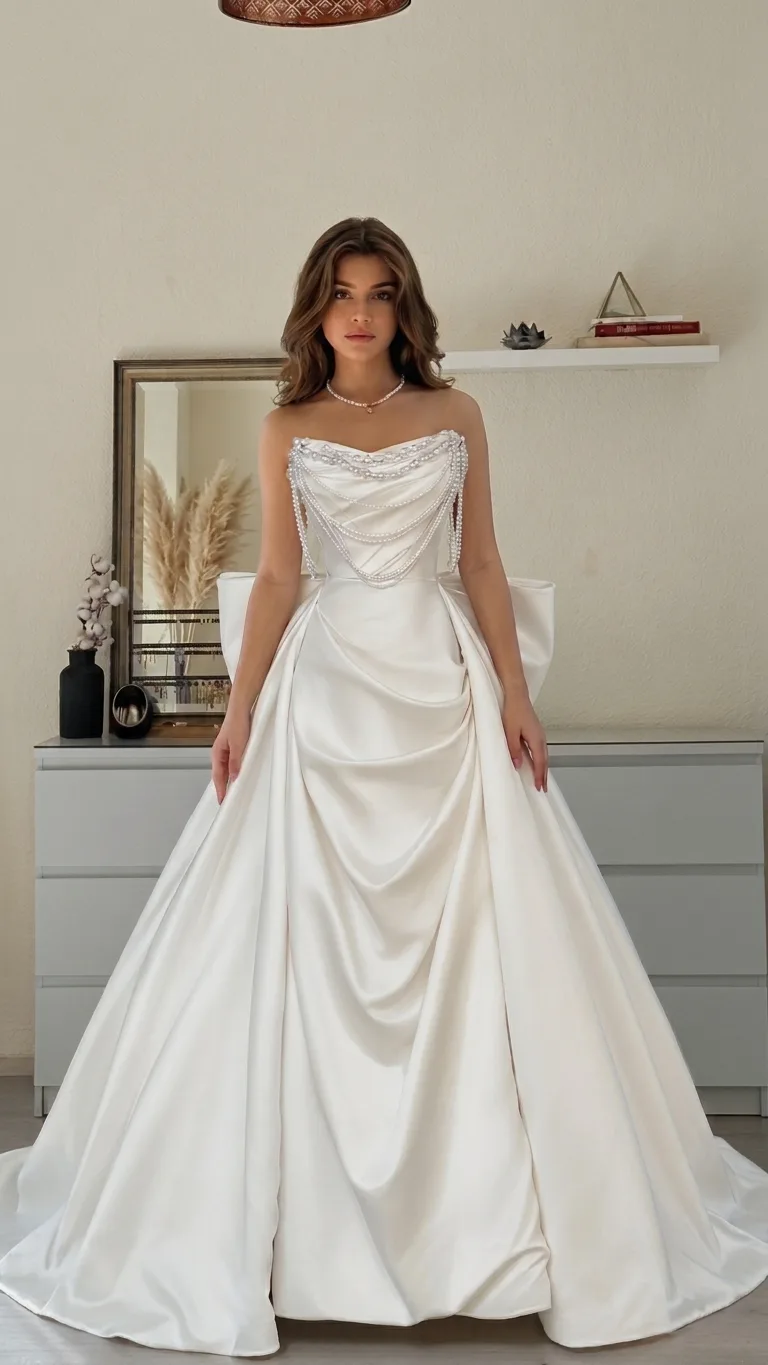
Satin ball gown with pearls and hip bows
A strapless satin ball gown, pearl strands across the bodice and at the shoulders, and large bows at each hip over a draped skirt and train. The bows are what stop a very full skirt looking unfinished. They give the waist a decision. Hair worn down, as it is here, keeps a second bow off the head. A short pearl necklace can repeat the bodice if you want one. The skirt needs an aisle, a photo corner and a dance floor that is not already full of chairs. Satin at this volume gets heavy by the end of a reception. Spend twenty minutes in the sample, including a sit, before you treat the mirror moment as the whole answer.
- Silhouette
- Ball gown with bows at the hip
- Ornament
- Pearls on the bodice, structure at the waist
- Hair
- Down, so the bows stay on the dress
- Needs
- Space to walk, sit and turn
Why it works — The bows mark the waist on a skirt that would otherwise be only volume, which keeps a ball gown looking considered.
Pearl-trimmed sweetheart A-line
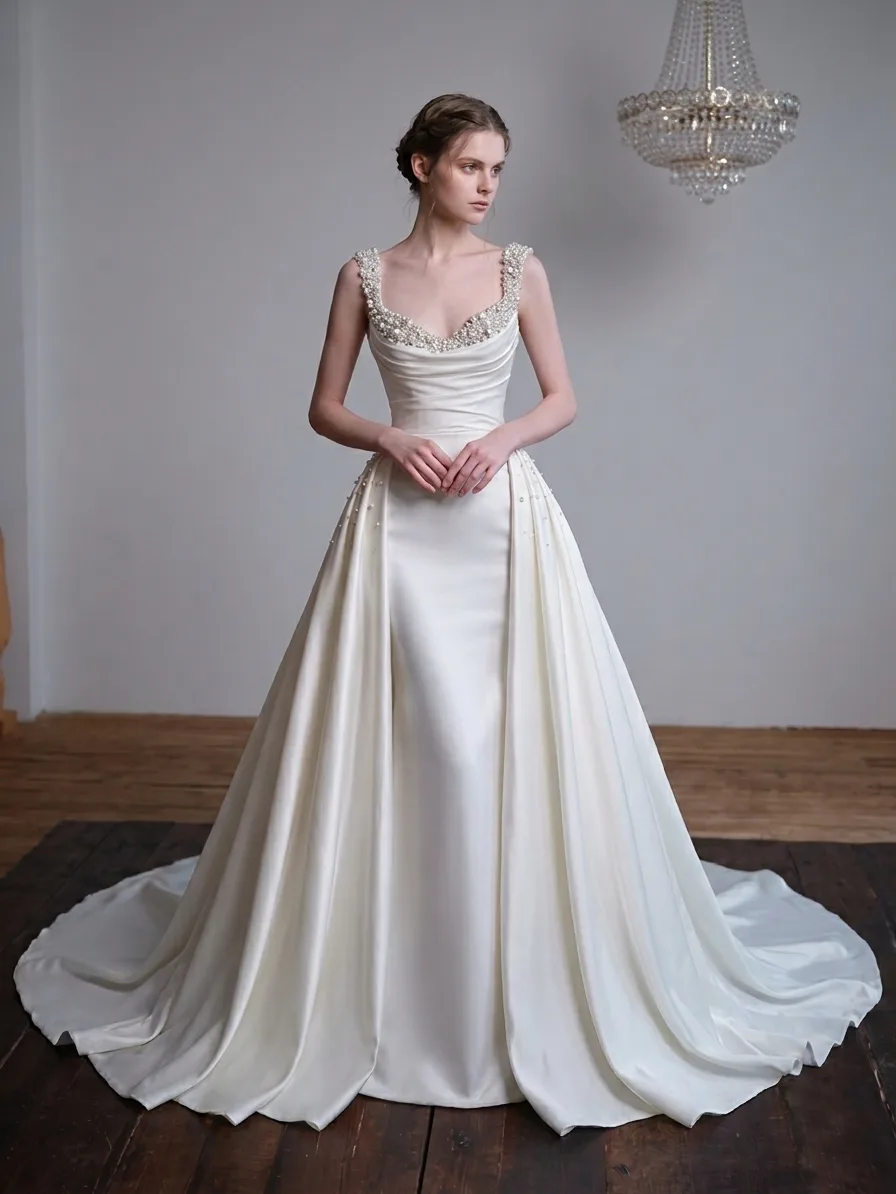
Ivory satin, a sweetheart neckline and straps covered in pearls, a fitted waist, then a full skirt with a few pearls near the hip and a train that pools. This is the elegant and timeless bridal gown shape: a marked waist, a skirt that flares, ornament kept above the bust. It photographs clearly from a distance, which matters in a group portrait where a narrow mermaid can disappear between two people. Studs are enough jewellery. A long veil has room here because the skirt is plain. The train is generous. On grass it will mark. On a polished floor someone needs to move it when you turn toward the guests. If your ceremony and your party are in different places, decide where the train is bustled before you leave the first room.
- Silhouette
- A-line, full skirt, long train
- Ornament
- Pearls at the neckline and straps
- Photographs
- Reads from across a group portrait
- Plan
- Who moves the train, and when it is bustled
Why it works — A clear waist and a quiet skirt make an A-line easy to read in a crowded wedding photograph.
Pearl-edged ball gown with a glittered skirt
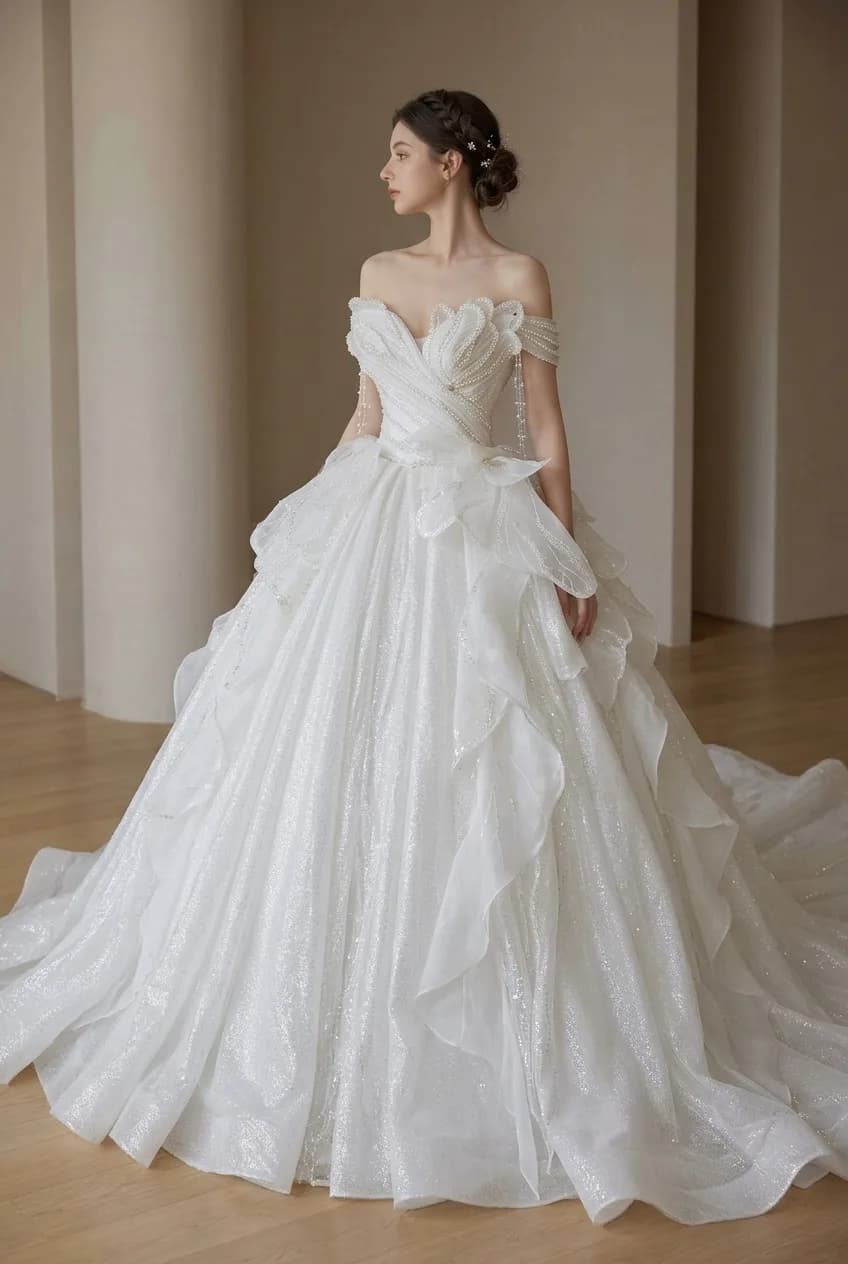
An off-the-shoulder neckline edged in pearls, a wrapped bodice, a bow and ruffle at the hip, and a full skirt covered in fine glitter, with a long train. Unique wedding dress ideas sometimes start from a classic ball gown and change only the surface. The glitter is that change. It belongs to evening, or to a reception that begins in late light and continues after dark. Noon sun makes this much sparkle harsher than the mirror suggested. The pearl neckline and the hanging strands are the jewellery. A small floral earring or a hair pin, and then stop. Glitter travels onto a partner's jacket and onto the car seat. If that bothers you, look for the same silhouette in a cloth with a softer sheen.
- Best light
- Evening, or a reception after sunset
- Surface
- Pearls at the neck, glitter through the skirt
- Jewellery
- Small earrings. The neckline is finished.
- Expect
- A little glitter on anyone you hug
Why it works — The shape is a familiar ball gown, and the glitter is the one update, so the dress feels romantic in evening light.
Modern and minimalist bridal gowns
Minimalist wedding dresses are rarely empty. They are dresses with a short list: one neckline, one change of volume, one piece of cloth that moves. The modern part is where that single detail sits. A peplum, a bell sleeve, a cowl or a sheer sleeve can make a plain ivory gown feel current without beading, and each of them asks something different of the room.
Strapless peplum with a pleated skirt
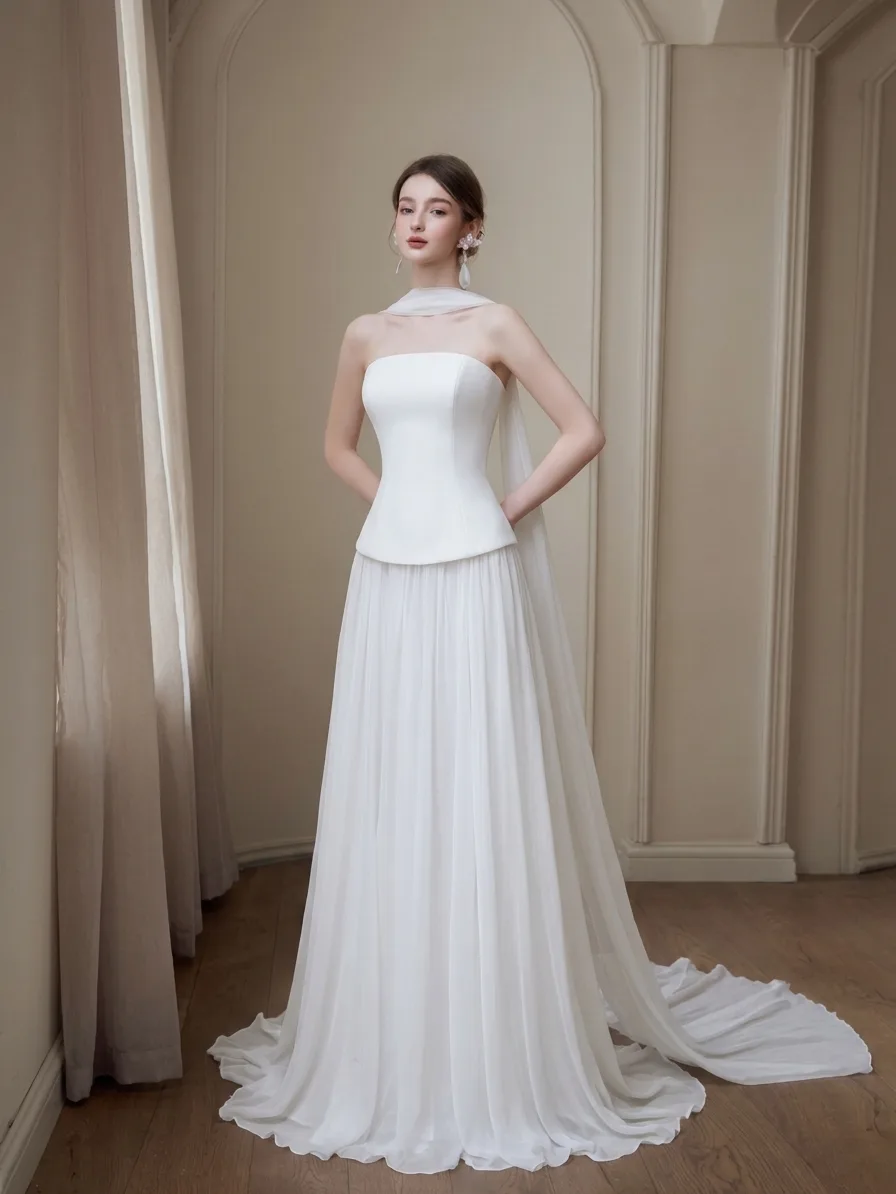
A structured strapless bodice, a short peplum, a softly pleated floor-length skirt, and a long sheer scarf at the neck that falls down the back. This is a minimalist wedding dress whose one dramatic piece is cloth. The peplum marks the waist without a ball skirt. The pleats move, which suits a city hall, a loft, a dinner, or a guest list small enough that you will be seen up close. The scarf is the veil. Wearing a veil as well splits a quiet dress into two ideas. Drop earrings and hair half-up leave the neck to the scarf. A peplum adds a little width at the high hip. If you want that width, this is a lighter way to get it than a hoop. If you want a narrow line from shoulder to hem, the cowl column below is the closer reference.
- Silhouette
- Strapless bodice, peplum, pleated skirt
- Best for
- Small weddings, city halls, dinners
- In place of a veil
- The long sheer scarf
- Adds
- A little width at the waist, and movement below it
Why it works — The peplum gives the waist a shape, and the scarf gives you a veil you can wear in every photograph.
Cowl-neck satin column
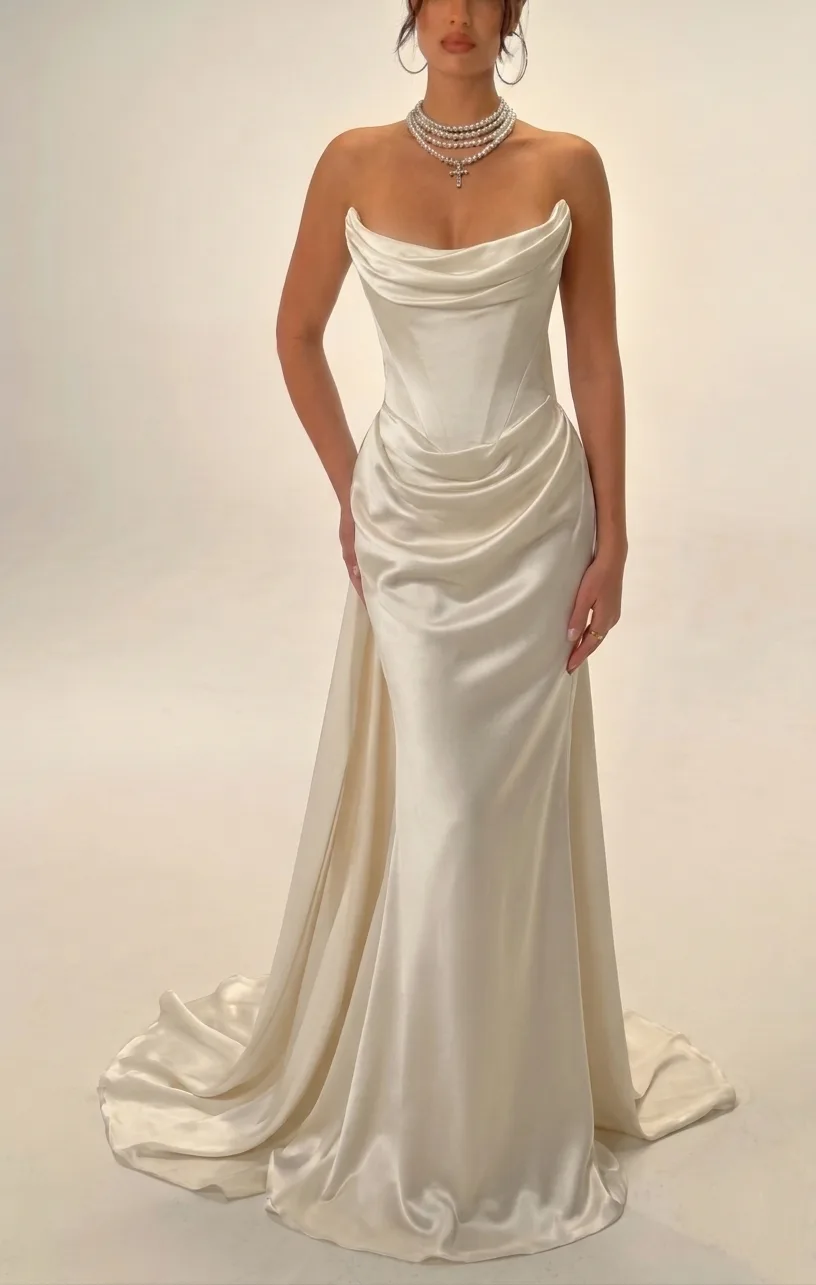
Ivory satin, a strapless cowl, draping gathered toward one hip, a column skirt and a short train. Modern bridal gowns of this kind depend on the fall of the cloth. There is no beading to distract from the fit, so the fit has to be honest. The cowl should stay against you when you lean forward to greet someone. The drape at the hip is the softening, and it suits a narrow room, a restaurant wedding, or a winter ceremony where a ball gown would fill the aisle. The portrait shows a multi-strand pearl necklace because the neckline is bare. That is the right moment for jewellery. A brooch as well would give a quiet dress two centres. Candlelight flatters satin. Creases that follow the drape are part of the design. Creases that cut straight across the lap are the ones to look at after you sit.
- Silhouette
- Column, with a drape at the hip
- Best room
- A narrow aisle, a dinner, evening candlelight
- Jewellery
- One necklace. The dress is otherwise plain.
- Test
- Leaning forward, and the lap after you sit
Why it works — The cowl and the hip drape supply the softness, so the column can stay narrow enough for a small room.
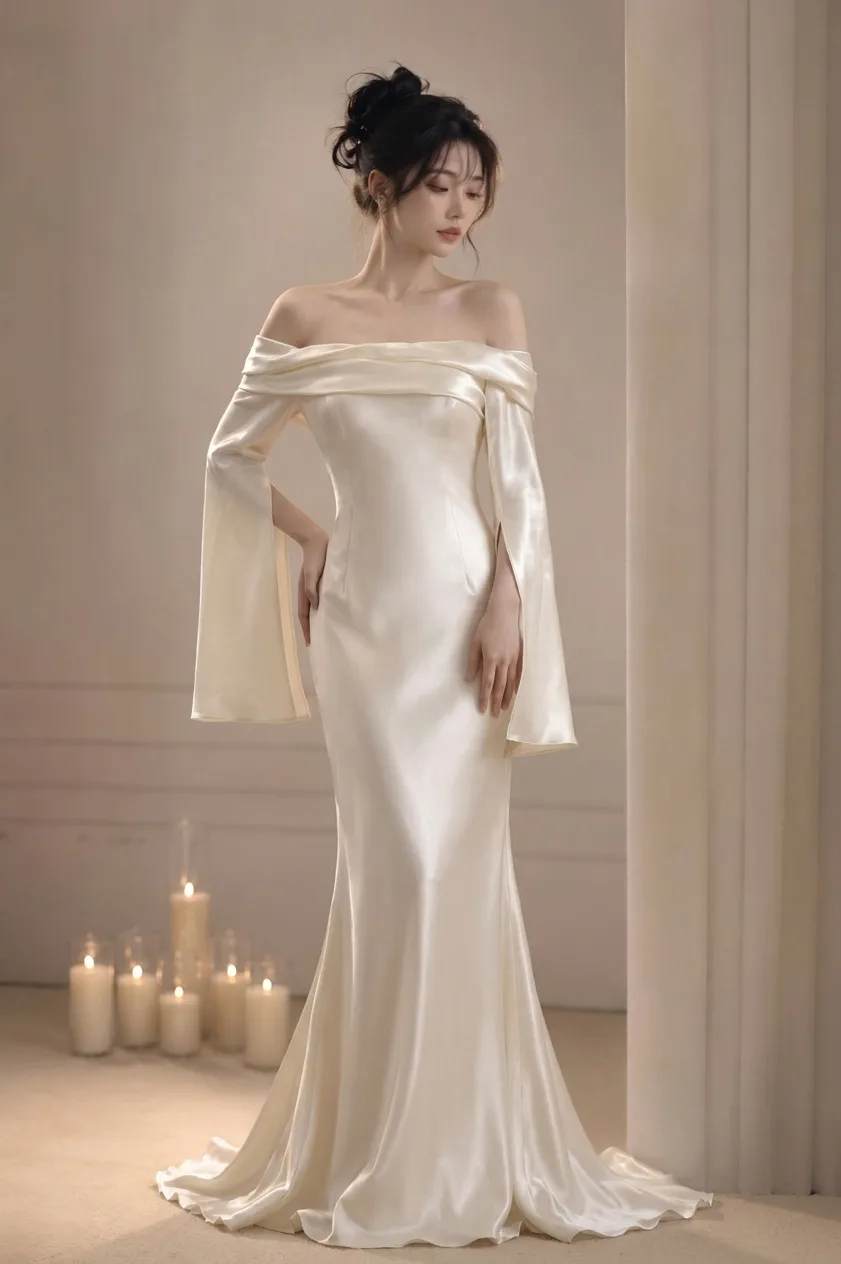
Off-the-shoulder satin with bell sleeves
Ivory satin, a folded band across the bust, long bell sleeves, a skirt fitted through the hip and a short train. Wedding dress ideas for modern brides often keep a classic cloth and change the sleeve. These sleeves cover the arm, which helps in a cool church or a heavily air-conditioned evening, and they widen the top so the fitted skirt looks longer. A low bun, as in the photograph, leaves the shoulders clear. A necklace would sit on the satin band and compete with it. Studs are plenty. The sleeves can dip toward a plate, so eat in them once during a fitting. The train is short enough to manage on your own, which matters at a wedding without a line of people behind you. This wants a hard floor. A lawn will mark the satin, and the sleeves have nothing to do with that problem.
- Detail
- Bell sleeves on an off-the-shoulder neckline
- Useful when
- The room is cool and you want your arms covered
- Train
- Short enough to handle without help
- Practise
- Eating, so the sleeves stay out of the plate
Why it works — The sleeves are the update on a fitted satin dress, and they double as the cover you would otherwise add later.
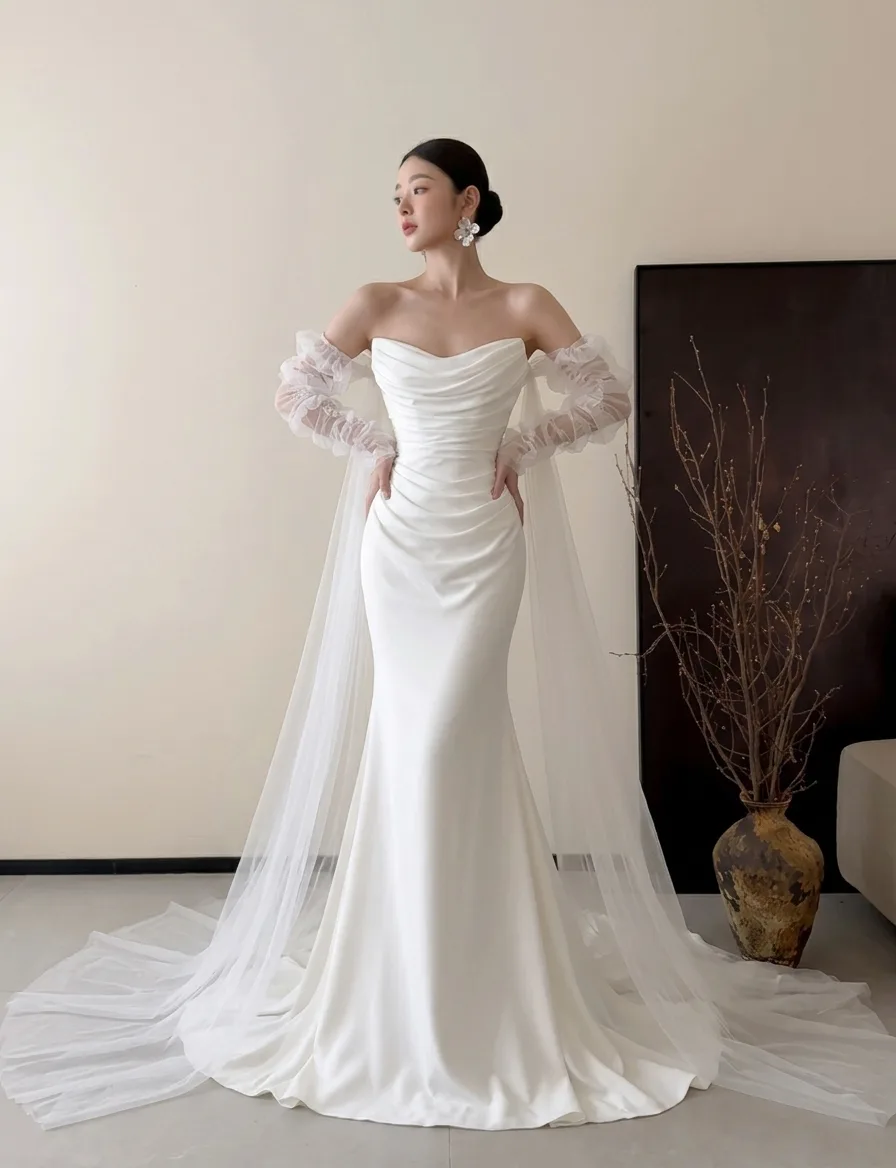
Ruched mermaid with sheer puff sleeves
A ruched strapless mermaid, off-the-shoulder sleeves of sheer cloth gathered into soft puffs, and a long sheer train. The body of the dress is close and modern. The sleeves are the romantic half, and they sit as a layer over the bodice. If a gown you try on lets those sleeves come away, you get a ceremony dress and a dancing dress in the same day. If they are sewn in place, treat them as the styling and leave the rest alone: a floral earring, a low bun, no veil laid over the puffs. Ruching follows the body more kindly than a smooth fitted panel, and it hides the crease a plain satin column shows the moment you sit. The train is light. At a garden ceremony it will lift in a breeze, so choose a sheltered spot for the vows or keep a hand on the tulle.
- Silhouette
- Ruched mermaid
- The one detail
- Sheer puff sleeves over a strapless bodice
- If the sleeves remove
- Wear them for the ceremony, and dance without them
- Outdoors
- A light train needs still air or a hand on it
Why it works — Ruching keeps a fitted dress comfortable, and the sleeves are a layer you can build the day around.
Statement wedding dresses
A statement wedding dress spends its attention in one place: a sleeve wider than the doorway, a bow the size of the bodice, a skirt of ruffles, a cape, or an overskirt that doubles the width. The rest of the gown can be plain. These are unique wedding dress ideas for a bride who wants the dress to be the scene. They need a venue with the room they take up.
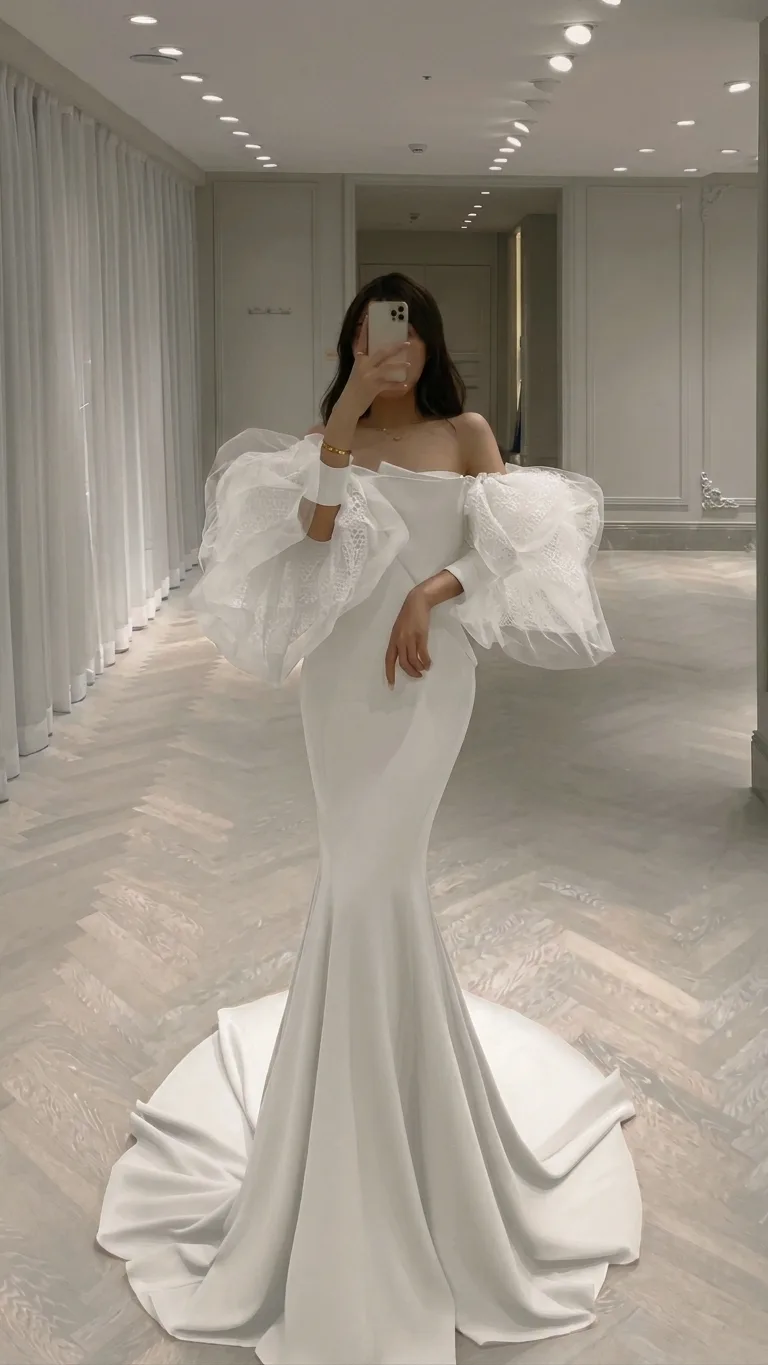
Mermaid with architectural organza sleeves
A clean white mermaid and a circular train, with sleeves so large they become the dress: structured organza, almost architectural, with a finer pattern inside the puff. One detail does the talking, which is why the skirt can stay undecorated. Hair at the shoulders, as in the photograph, lets the sleeves own the frame. A veil over them would bury the reason you chose the gown. Measure the width against the life of the day. An aisle between pews, a car door, a hug, the chair beside you at dinner: the sleeves need more room than the skirt. They are extraordinary in a straight-on portrait in a quiet hallway. They are a project in a packed cocktail hour. If you love them, give them the space, and keep jewellery to a fine chain.
- The statement
- Oversized structured organza sleeves
- Skirt
- Plain mermaid with a circular train
- Veil
- Leave it off. It covers the sleeves.
- Measure
- Aisle, car door, and the chair beside you
Why it works — The skirt stays simple so the sleeves can be the entire point of the photograph.
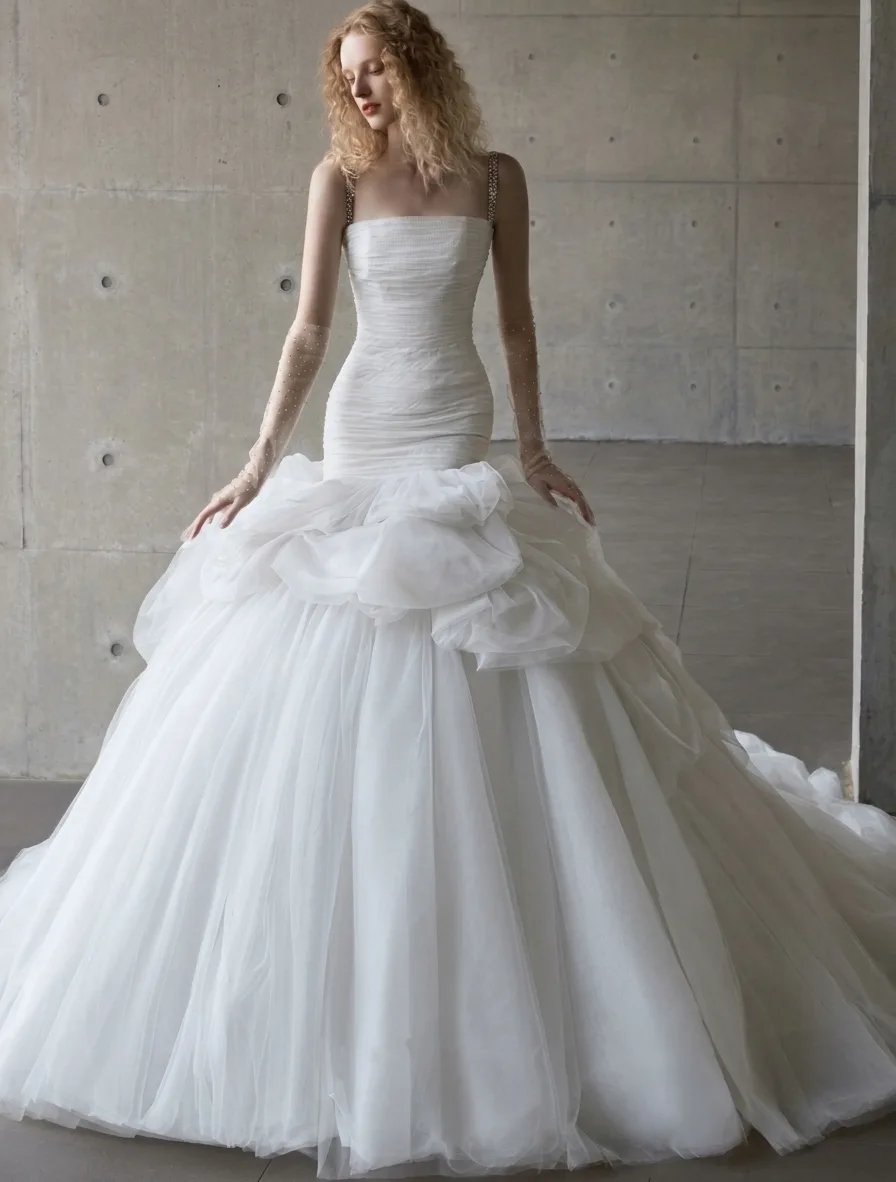
Ruffled tulle ball gown with opera gloves
A ruched strapless bodice on thin beaded straps, then a skirt that breaks into large ruffles and a cloud of tulle, worn with sheer opera gloves that sparkle. Gloves return whenever a bodice is this controlled and a skirt is this large. They belong to the entrance and the portraits. Take them off to eat, to hold a drink, and to dance if they slip. The ruffles add width from the hip, so the bodice has to fit closely or the shape goes wide in every direction. A plain wall, like the one in the photograph, shows the volume. A busy floral backdrop would compete with it. Plan the car. A skirt this wide wants the front seat pushed forward, and a friend who has practised packing tulle without sitting on the ruffles.
- Silhouette
- Fitted bodice, ruffled tulle ball skirt
- Gloves
- For the entrance and the portraits
- Remove to eat
- The gloves
- Plan
- The car, the doorway, and a plain background
Why it works — The bodice stays close so the ruffles have a waist to explode from, and the gloves finish the portrait.
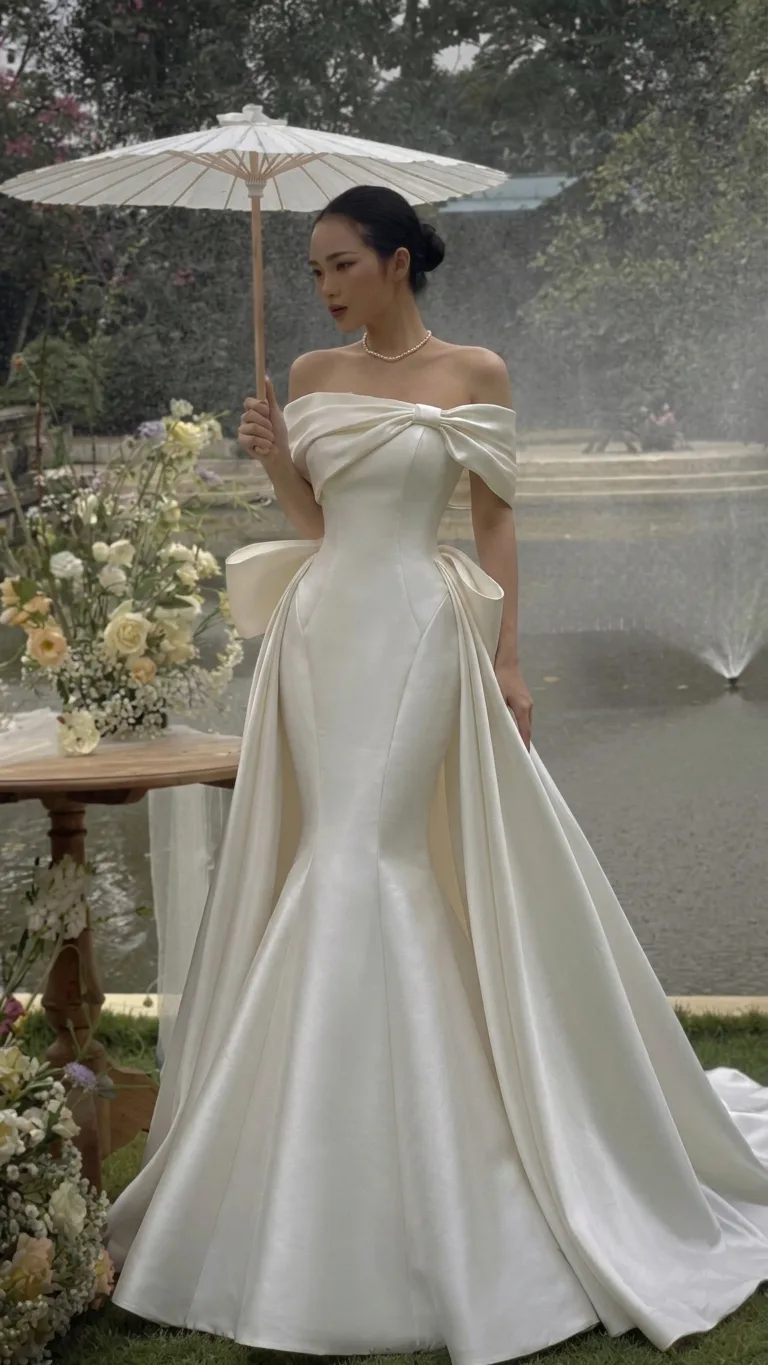
Satin mermaid with an architectural bow
Ivory satin, off the shoulder, with a bow large enough to set the width of the top, a fitted line through the hip, and a train opened across the grass. The bow replaces the beading a mermaid often uses to give the neckline a point. In the photograph there is a short pearl necklace, a bun, and a garden beside water. That is the right amount of styling. A bow in the hair would repeat the dress in the wrong place. Satin on a lawn marks. If the ceremony is on grass, decide when the train is bustled, and look at a hem that has already met the ground so you know what the cloth does when it is damp. The bow has structure. Check that it does not press into the upper arm after an hour, and that you can lift a glass without the shoulder piece shifting.
- The statement
- One large bow at the neckline
- Setting
- A garden, if you accept a train on grass
- Jewellery
- A short strand of pearls
- Test
- The bow after an hour, and a hem that has touched the lawn
Why it works — The bow gives a fitted satin mermaid its shape at the shoulder, so the skirt can stay a clean line.
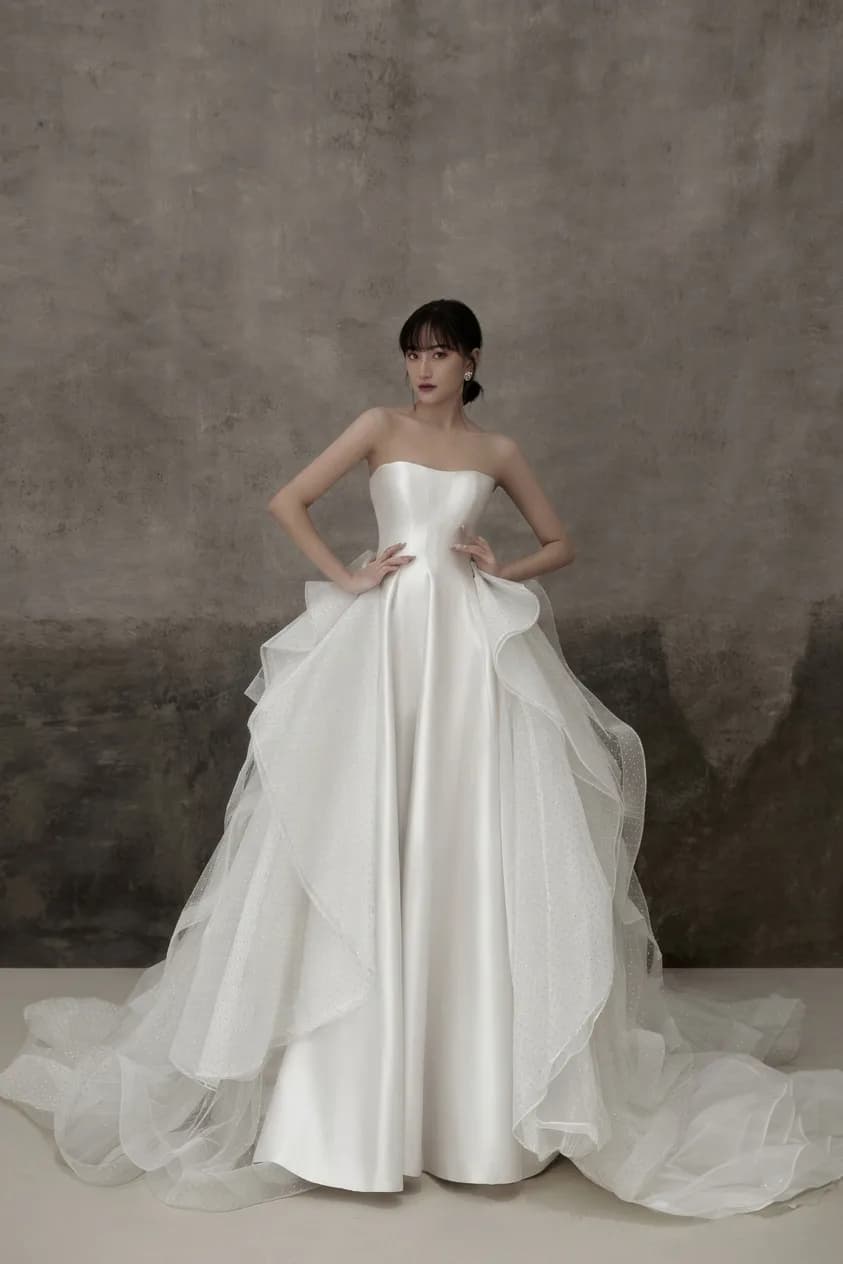
Satin ball gown with a dotted tulle overskirt
A strapless satin ball gown with a clean bodice, and a dotted tulle layer that flares wider than the satin and pools into a train. You are looking at two shapes. The satin is the line. The tulle is the volume, and the dots catch light so the overlay stays visible against the satin in a photograph. A ballroom or a plain ceremony suits it better than a windy clifftop. Tulle catches air, and a breeze will put the overskirt into the next person. If the overlay on a dress you try on is separate, the satin alone is a dancing dress. If it is sewn on, the volume stays all night, so walk a doorway and sit in it. The earrings in the portrait are small. Follow that. The skirt is already the noise.
- Two layers
- A satin ball gown under dotted tulle
- Best air
- Indoors, or outdoors with almost no wind
- If it separates
- Satin for dancing, both layers for the ceremony
- Practise
- A doorway, and sitting
Why it works — The dots keep the tulle from disappearing into the satin, so both shapes show in the photograph.
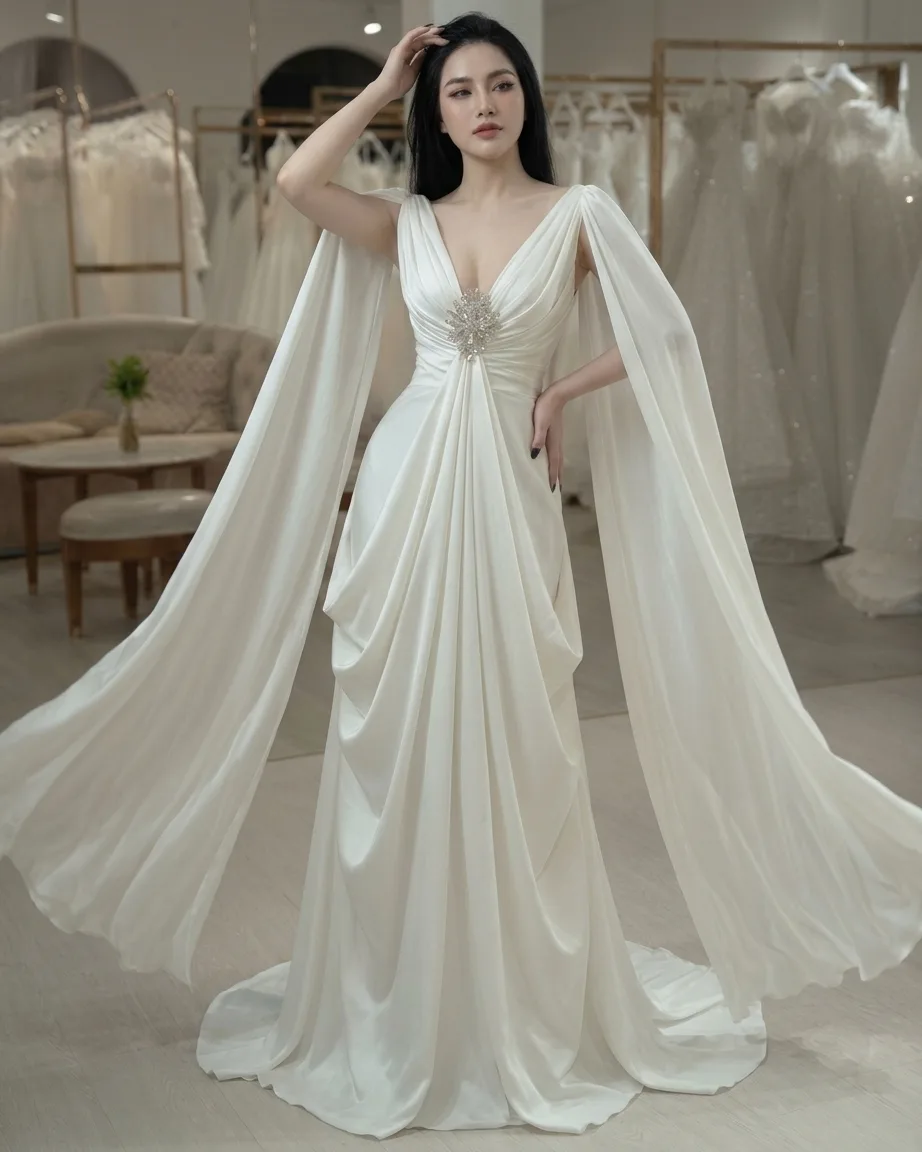
Draped column with cape sleeves
A deep V, ivory cloth draped through the body, a crystal brooch at the waist, and cape sleeves that fall past the hands and continue into the train. The cape is a veil, a jacket and a sleeve. That is the appeal for a bride who wants cover in the photographs, rather than a bolero that comes off the moment the camera appears. The brooch is the jewellery. A necklace in the V would split the point the brooch is holding. Hair swept off the neck lets the cape fall. The drape is soft, which follows more bodies than a heavily structured mermaid, and the length and the brooch still make it read as a wedding dress. At dinner the cape will try to sit in your lap and in your neighbour's. Gather it the way you would a scarf before you sit down to eat.
- The statement
- Cape sleeves and a brooch at the waist
- Covers
- Arms and back, without a separate jacket
- Jewellery
- The brooch. Leave the neckline clear.
- At the table
- Gather the cape before you sit
Why it works — The cape means you arrive covered, and the brooch gives a soft draped dress one hard point of focus.
Floral and nature-inspired wedding dresses
The floral inspired wedding dresses here are constructed. One builds a rose from the same cloth as the skirt. One repeats raised flowers from the bodice onto the veil. One embroiders a silver vine. One makes the skirt itself out of petal-shaped ruffles. The styling rule is the same for all four: the dress has already chosen the flower. The bouquet, the hair and the veil should repeat it or get out of its way.
Ball gown with a rose at the hip
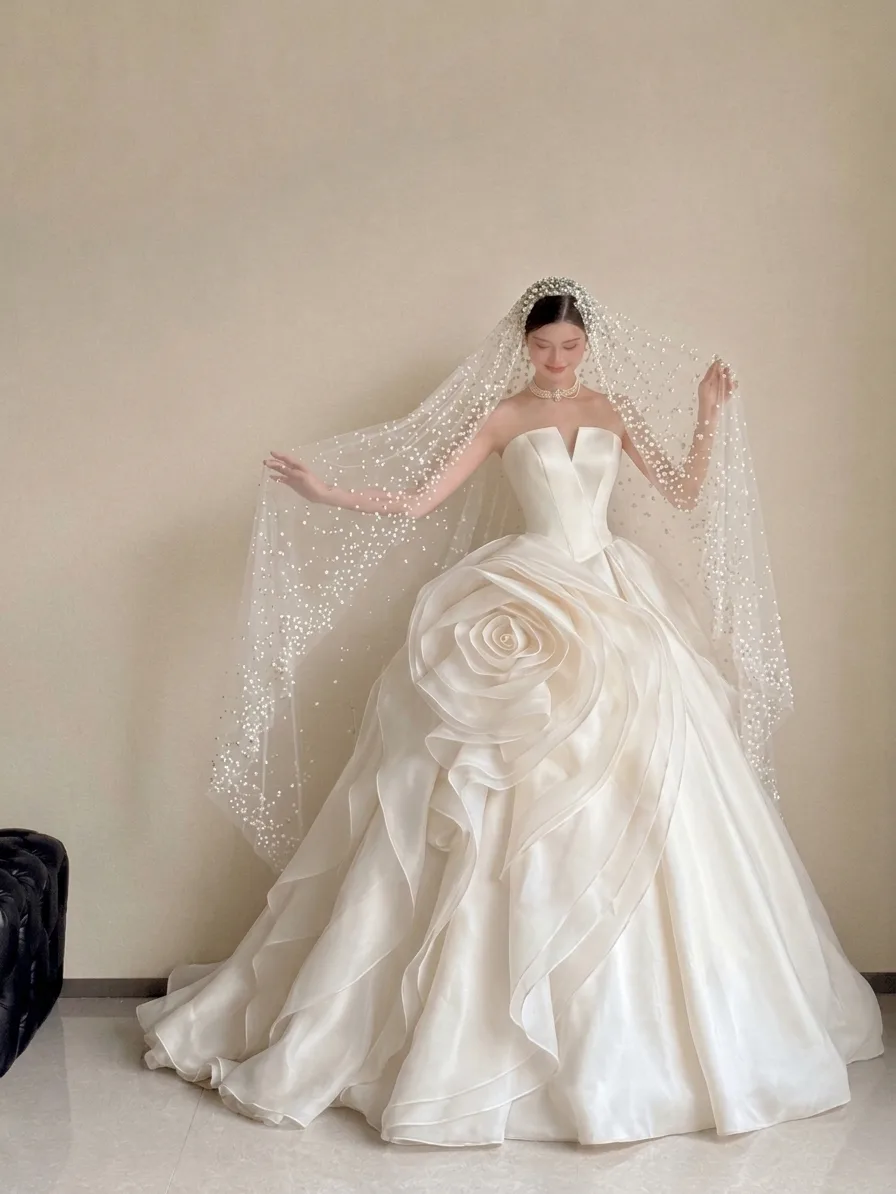
A strapless satin ball gown with a sweetheart neckline and a rose built from the same cloth at the hip, large enough to be the flower of the dress. A long veil scattered with small pearls frames it. A constructed bloom keeps the rest of the skirt plain, which is why the rose reads from across the room. The veil is already detailed. The comb that holds it is the headpiece. A tiara on a pearl-scattered veil would be a second crown. Because the hip is a rose, hold the bouquet away from that side: white stems or greenery, so the two flowers do not merge. The rose is firm. It will not collapse when you sit, so sit toward the other hip if you can. The skirt is still a ball gown, and it needs the same clear floor as the other full dresses here.
- The flower
- A cloth rose at the hip
- Veil
- Long, scattered with pearls
- Bouquet
- Plain stems, held off the rose
- Sitting
- Toward the hip without the rose
Why it works — One large bloom on a plain skirt is easier to read than a dress covered in smaller flowers.
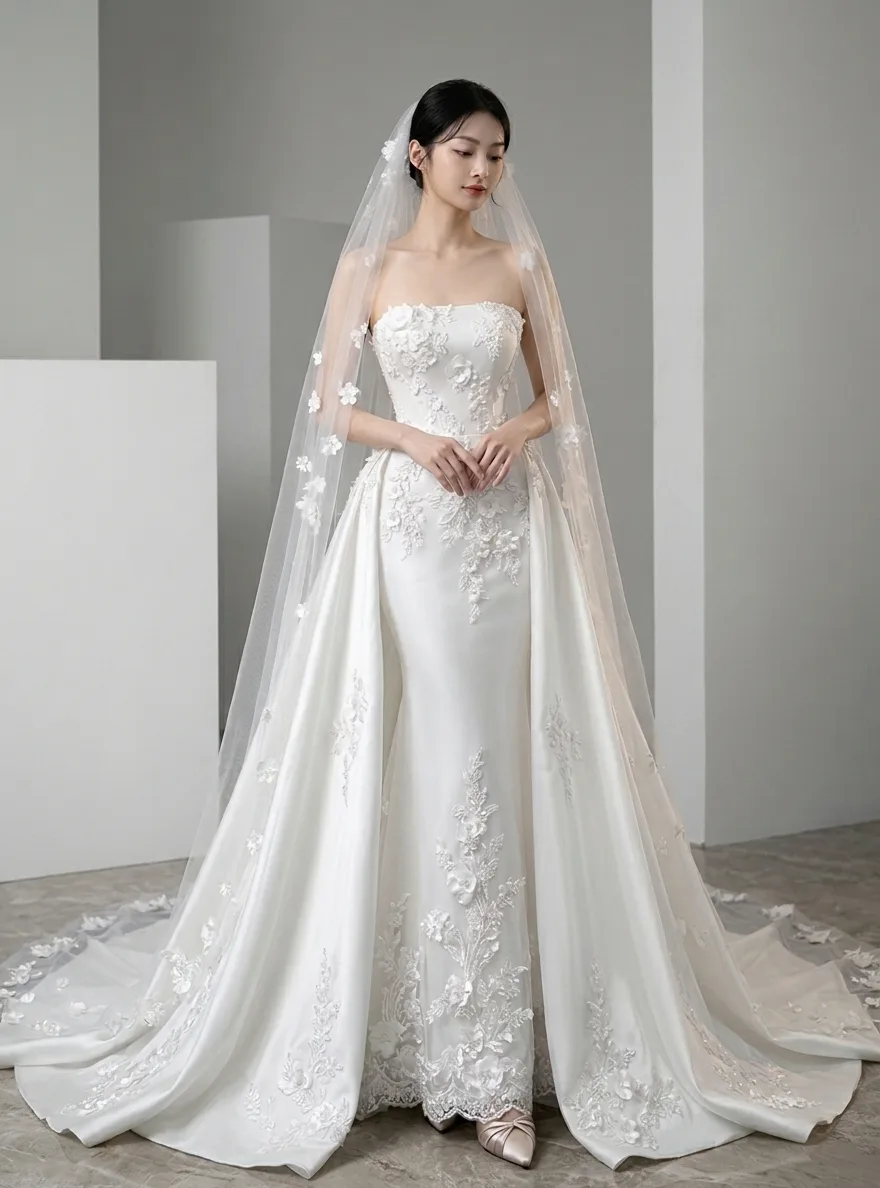
Mermaid with floral appliqués and a matching veil
A strapless satin mermaid with raised floral appliqués from the bodice down one side of the skirt, and a long veil scattered with the same flowers. The repetition is the design. This veil belongs to this dress in a way a plain tulle veil would not. A flower crown, or a bouquet of the same blooms pressed against the appliqué, starts to blur the line between dress and styling. A small bunch held low leaves the flowers on the cloth visible. The shoe in the photograph is a pale pointed heel, which disappears under the hem on a hard floor and keeps the attention on the appliqués. Raised flowers can catch a ring, a wrap, or the edge of the bouquet. Run a hand over them. In a bright room or a garden the relief shows. In a very dark reception the flowers flatten, and you are left with the mermaid, which still has to let you walk.
- Detail
- Raised flowers on the dress and again on the veil
- Bouquet
- Small, and held away from the appliqué
- Shoe
- A pale heel that disappears
- Light
- Bright enough that the flowers keep their relief
Why it works — The veil repeats the dress instead of introducing a new trim, so the floral idea stays singular.
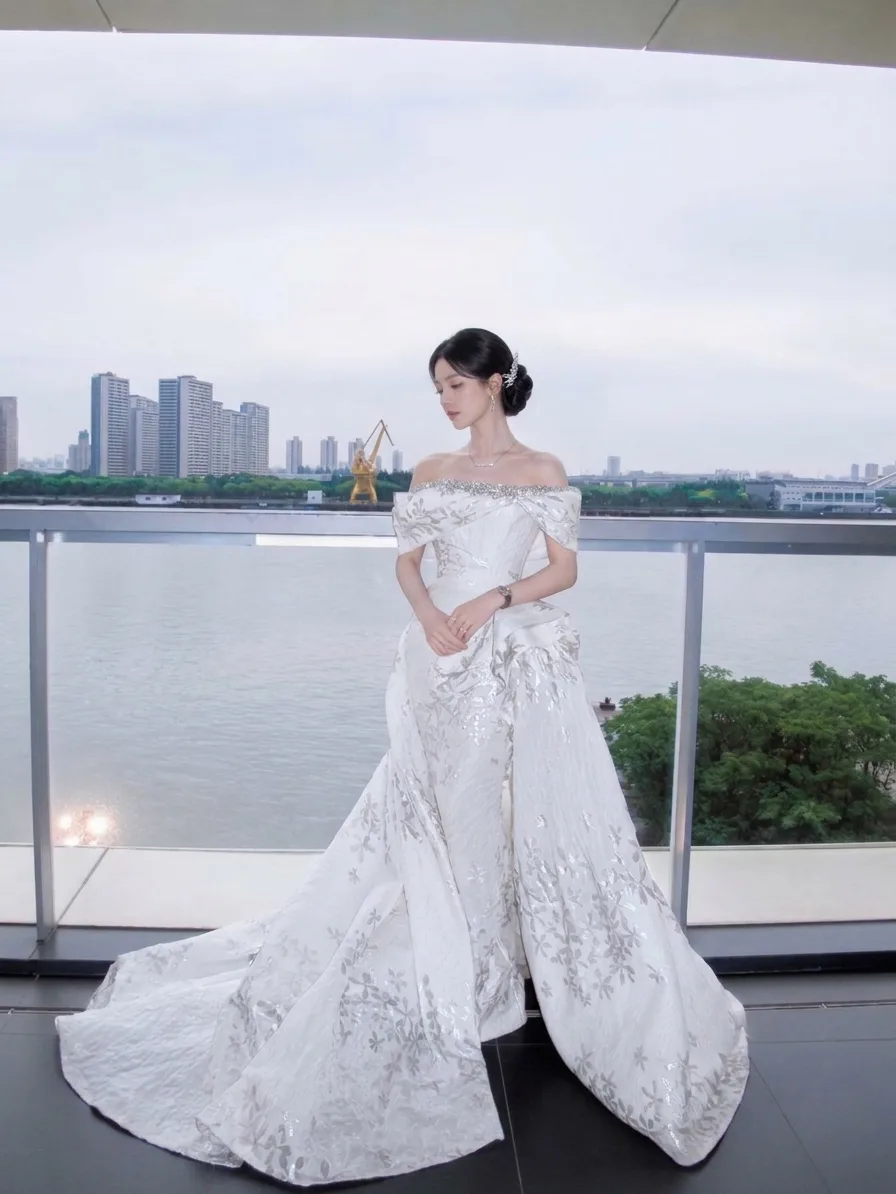
Off-the-shoulder gown with silver floral embroidery
An off-the-shoulder white gown with silver floral embroidery over the bodice and down the skirt, a fitted hip, a flare, and a long train. The silver is a cool metal. Earrings and a thin necklace should agree with it, as they do in the photograph. A warm gold collar would argue with the thread. Embroidery this extensive is both the jewellery and the flower. A veil covered in more blooms is unnecessary. A plain long veil can frame the train if you want length behind you. The train is a commitment on a terrace, near steps, or anywhere you have to turn. Someone walks behind you, or you bustle it before you move. Soft daylight lets white-on-white embroidery show. Hard midday sun can blow the ground out and leave only the silver. If the ceremony is at noon in the open, look at the dress outside first.
- Surface
- Silver floral embroidery on white
- Metal
- Cool tones, to match the thread
- Train
- Needs a person, or a bustle, before you climb a step
- Light
- Soft daylight. Harsh sun flattens white cloth.
Why it works — Silver thread gives a white gown a floral pattern that still shows when the cloth itself is bright.
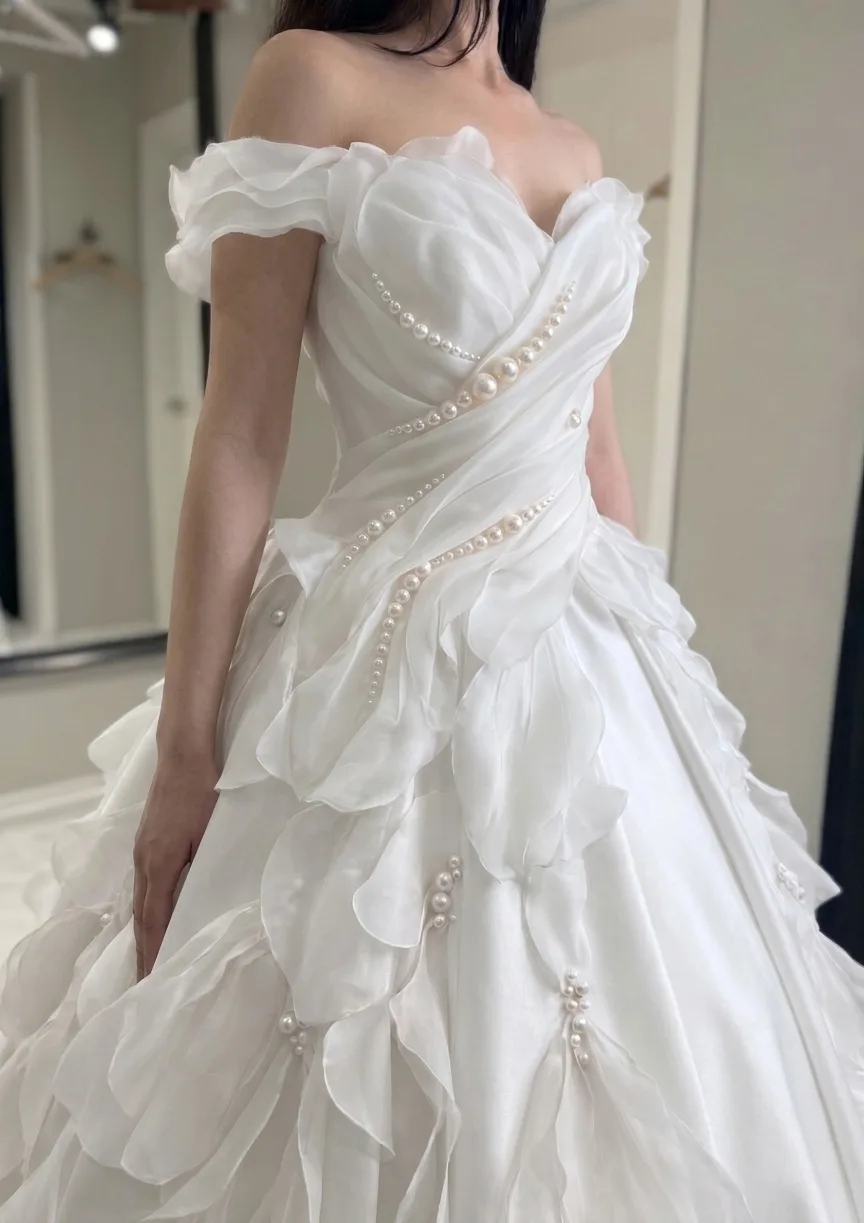
Petal ruffles traced with pearls
This photograph is a close view, and it is useful for that reason. The bodice and skirt are built from layered, petal-shaped ruffles, with strands of pearls following the drape and small pearl clusters on the skirt. The surface is the wedding gown detail. Petals and pearls together read as floral and romantic without a printed flower. They are also a lot of texture against the skin and against a partner's jacket. Ask what the underside feels like at the waist. A beautiful top layer over scratchy net is a long reception. The bodice is already covered, so a pendant would land on pearls and disappear. Hair up, small earrings, and a bouquet held a little away from the skirt keep the layers readable. White flowers on long stems do that better than another mass of petals pressed into these ones.
- Surface
- Petal-shaped ruffles and pearl strands
- Ask
- What the underside feels like at the waist
- Hair
- Up, so the neckline frame stays clear
- Bouquet
- Long stems, held off the ruffles
Why it works — The ruffles do the work of a flower, and the pearls trace the drape so the eye can follow it.
The tulip-inspired wedding dress
A tulip is a useful flower to borrow from, because the shape is already close to a gown. The bloom is a cup. The petals stay close near the stem and open as they rise, and a single leaf wraps the stalk. The dress in this photograph takes that structure and keeps it inside a bridal silhouette, which is why it feels artistic without becoming a costume.
The bodice is strapless and pale, closer to ivory than to leaf. At the waist a green panel crosses and finishes in a soft point, the way a tulip leaf sits against the stem. Below that, the skirt falls in long vertical panels of ivory and sage. They read as petals: light cloth, layered, opening toward the hem and then spreading into a train across the grass. The green is strongest near the waist and quieter toward the edge. That proportion is what keeps the gown bridal. Ivory remains the ground. Green is used the way a flower uses a leaf.
The bouquet is a handful of white tulips. It repeats the idea once. A mixed bunch would introduce flowers the dress did not ask for. The hair is worn down, with one white bloom at the temple. A long veil would cover the leaf at the waist in half the portraits, and the leaf is the point. The flower in the hair does, at a smaller scale, the work a veil would have done.
A tulip-inspired bridal gown suits a bride who wants the day to feel romantic, feminine and a little apart from a plain white ball gown, and who is getting married somewhere the colour has light. A garden, a greenhouse, a courtyard, a late-spring afternoon. The cypress and the lawn in the photograph are part of the styling. In a dark ballroom the sage can go dull, and layered panels lose the petal shape if no light comes through them. On grass, a pale train marks. Plan to lift it once the portraits are done, and look at the hem after it has met a damp lawn so you know how the cloth behaves.
The skirt moves, and it also takes space in a breeze. Hold a panel when you walk if the day is windy. The strapless bodice has to stay up on its own, so raise your arms, sit, and look at the back, because the train will be what most of the ceremony sees. If the green is dyed rather than woven as a pattern, ask how it looks after strong sun and against skin. You want the colour in this photograph, including after an hour outside.
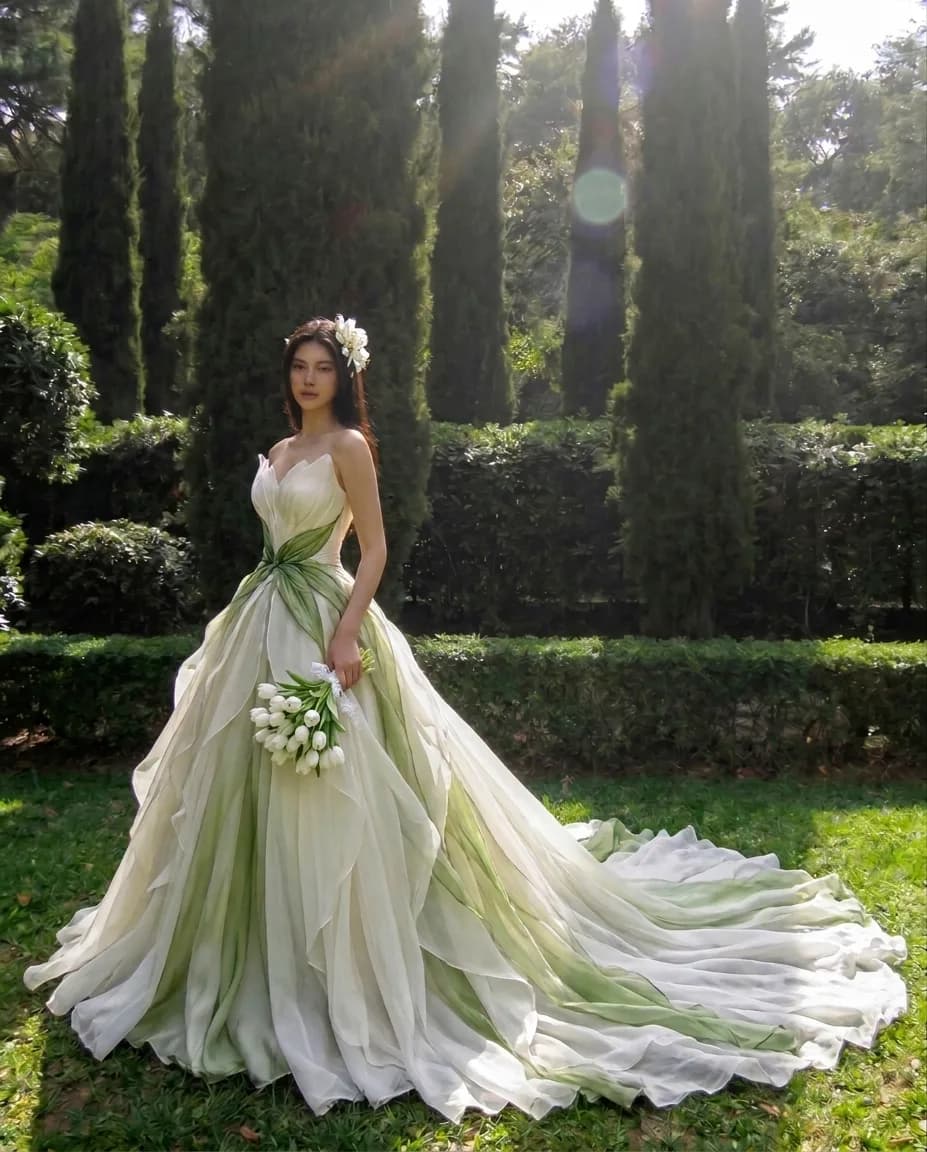
Ivory and sage tulip ball gown
In the photograph the gown is strapless and ivory through the bodice, with a green wrap at the waist and a ball skirt of ivory and sage panels that pools into a train. White tulips in the hand and a single white flower in the hair are the whole of the styling. Treat that as the edit. A cathedral veil, a second necklace and a larger bouquet would cover the leaf, and the leaf is the reason for the dress. Wear it where the green has light: a garden ceremony, a glasshouse, a daytime celebration in soft sun. Take the train off the grass once the portraits are done. A block heel or a wedge survives a lawn better than a stiletto, and the skirt will hide the shoe until you take a step.
- Silhouette
- Ball gown with a leaf-like waist
- Colour
- Ivory, with sage through the skirt panels
- Styling
- White tulips, and one flower in the hair
- Watch
- Wind in the panels, and a train on grass
Why it works — Green is concentrated at the waist and washed through the skirt, so the dress stays bridal and still carries the shape of the flower.
How to choose a wedding dress that suits your style
How to choose the perfect wedding dress is a sequence, and the sequence matters more than the first gown you loved online. Start with the ceremony you are having, then the silhouette you can move in, then the cloth, then the question of whether you want the dress to feel traditional, modern, or like a flower. Personal taste is the last filter and the one that decides it. A gown can pass every practical test and still be wrong if you feel costumed in it.
Choosing a silhouette
Wedding dress silhouettes in this guide fall into a few families, and wedding dress inspiration for different body types works better as a question about the line you want than as a chart that assigns you a shape.
- A ball gown, like the tulip dress, the rose-hip gown or the pearl bow gown, marks the waist and lets the skirt carry the width. It gives a smaller frame presence in a large room, and it lets a fuller hip disappear into the skirt. Some brides want that disappearance. Some miss seeing the line of their body and feel lost in the cloth. The skirt needs a wide aisle and a clear patch of floor for photographs.
- An A-line, like the pearl sweetheart, flares from the waist with less architecture at the hip. It is often the easiest first appointment, because it asks less of the room than a ball gown and less of your stride than a mermaid.
- A mermaid follows the hip and the thigh, then releases into a train. You see the body. The crystal plunge, the organza sleeves, the bow and the floral appliqué are all this family. Sit, and walk a staircase, before you decide. If the skirt eases below the knee, a normal step comes back.
- A column, like the cowl or the cape, is a long line with less cloth to manage. It suits a narrow city venue and a bride who wants the drape of the fabric to do the flattering. There is nowhere for a poor fit to hide, which is a kindness if you like an honest mirror and a problem if you wanted the skirt to disguise the hip.
- A peplum marks the waist with a short flare and leaves the skirt lighter. It is the middle path when you want shape and you also want to dance without gathering an armful of tulle.
Try the silhouette you think is wrong for you, once. A bride who has always avoided full skirts sometimes finds that a ball gown is the first dress that makes her stand differently. A bride who arrived wanting a mermaid sometimes prefers the column the moment she sits down to dinner in the sample. The appointment is for that discovery. The photograph you saved is the starting point.
Venue and season
Match the dress to the ground, the light and the temperature. The tulip gown, the bow mermaid and any long train are garden dresses only if you will accept grass, pollen and a hem that has touched the lawn. The silver floral train wants a person behind you the moment there is a step. The glittered ball gown and the crystal mermaid want evening light. The dotted overskirt and the organza sleeves want still air and a wide door.
Season is a clothing decision. A strapless satin ball gown in July, in full sun, is hot, and white cloth blows out at noon. A strapless gown in a December church needs a cover you are willing to wear in the portrait: the cape sleeves, the bell sleeves, or a wrap in a close colour. Sheer puff sleeves look light and can still be warm if the day is humid. Our guides to summer clothes and winter clothes are about ordinary dressing, and the same test applies here. If you would be cold or overheated in that cloth at that time of year, a wedding does not change the weather.
Fabric and comfort
Judge the cloth by what it does across twelve hours. Satin shines, photographs richly in candlelight, creases at the lap, and can feel cool at the vows and warm by the speeches. Tulle makes volume, catches wind, and can scratch at the waist if the soft layer stops too high. Lace hides a small crease and shows its lining, so the lining colour is part of the dress. Light layered panels, as on the tulip gown and the petal ruffles, move beautifully and cling if the lining is skimpy. Pearls and beads add weight to the shoulders by the last hour. Glitter sheds. Raised appliqués can snag.
Traditional or modern
Traditional, in this set, looks like lace and pearls, a satin A-line, a cathedral veil, a crystal neckline on a mermaid. Modern looks like the peplum and scarf, the cowl column, the architectural bow, the organza sleeves, the cape. You can mix them. The ruched mermaid with sheer sleeves is a modern body with a romantic layer on top. The question to ask is which half of the day you want the photograph to remember. A classic silhouette with one current detail ages more quietly than a dress that is trying to be every bridal fashion trend in the same mirror. Bows, capes, peplums and very large sleeves are all in circulation. Choose one because it suits the wedding, and leave the others for someone else's photographs.
A dress that reflects your taste
Look at what you already wear when the day is ordinary and you feel like yourself. If your wardrobe is plain, close to the body, and free of prints, a cowl column or a peplum gown will feel like a formal version of you. If you gravitate to texture, florals and softness, the lace and pearls, the appliqués or the tulip gown will feel more honest than a severe column you admired on someone else. If you like a room to notice you when you walk in, the organza sleeves, the ruffled ball gown or the bow are speaking your language.
Taste also includes the wedding you are hosting. A greenhouse and a black-tie hotel can both be yours. They should not wear the same dress. When a gown flatters you and fights the room, the room wins in the wide photographs, and you spend the day managing cloth. When it flatters you and belongs there, you get to forget about it for an hour, which is the most useful feeling available in a wedding dress.
How to style your wedding dress
Styling should agree with the dress and then stop. The gowns above already show the edit: one headpiece or none, one metal, a bouquet that repeats the dress or stays plain, a shoe for the ground. Use those portraits as the ceiling.
Veils and headpieces
- A pearl-scattered veil belongs with the rose ball gown because the veil is doing floral work of its own. The comb is the headpiece. A tiara on top of that veil is a second idea.
- A veil scattered with the same appliqués as the mermaid is part of the dress. A plain veil is a fair swap. Leave a flower crown off.
- The tulip gown uses a single bloom at the temple. That keeps the green waist visible. A cathedral veil would hide it.
- The peplum gown's sheer scarf is the veil. A second layer of tulle repeats a dress that was designed to be quiet.
- The organza puff sleeves and the cape should stay unveiled. Both are already doing a veil's job.
- A long veil outdoors needs a person and a wind check. The same length in a still ballroom is mostly a matter of not stepping on it.
Bridal shoes
The floral appliqué mermaid shows a pale pointed heel because the floor is hard and the flowers are the story. A garden, which is where the tulip gown and the bow mermaid are standing, wants a block, a wedge or a heel you have already survived on grass. A stiletto sinks, and a train hides the shoe until you walk, which is when everyone sees you pause. Bring the shoes to the fitting. A higher heel shortens the dress, and a mermaid that pooled in bare feet can become a hem you trip on once the shoe is on. The shoe guide is about everyday pairs, and the rule travels: if you cannot walk the room, the outfit is not finished. Have a second pair in the room for the last hour if the first pair is for the portraits only. Change them where the photographs are already done.
Jewellery
Scale comes from the neckline, which is the short version of the jewellery guide. The lace gown's pearl swags are a necklace, so the portrait uses a single pendant in the open space and stops there. The cowl column is bare, so a multi-strand pearl necklace has a job. The cape's brooch is the jewel, and the neck stays clear. The crystal plunge is bright enough that studs, or the small drops in that portrait, are the ceiling. The silver floral embroidery is a cool metal, and the earrings should match it. One metal tone through earrings, necklace and hair pin is calmer than a mix, especially against ivory, which shows every clash. If the dress has pearls, crystals or a brooch, you have already chosen the jewellery. Anything else has to be smaller than that.
Hairstyles
Hair up, or in a low bun, when the neckline, the back or a veil attachment is the point. That is the rose gown, the floral appliqué, the bell sleeves, the silver embroidery and the petal ruffles. Hair down when you want a soft edge on a strapless neckline, as with the tulip gown, or when the sleeves are so large that an elaborate updo would compete, as with the organza puffs. The pearl bow ball gown wears hair down for the same reason: the bows are enough decoration at the waist. A half-up style suits the peplum and scarf, because the scarf needs the neck and the hair can still move. Pin for the weight of a cathedral veil, and rehearse the hug, the wind and the car. A style that survives the portrait and collapses at the table will be the one in the dinner photographs.
Makeup
Match the face to the light, then to the dress. Garden daylight, which is the tulip gown and the bow beside the water, washes a very pale lip out against ivory. Brows, a lip colour you can see in sun, and a base that has been looked at outdoors will hold up against bright trees. Candlelight on satin, as with the bell sleeves, reflects onto the face. A slightly deeper lip and a defined eye keep you from disappearing into the shine. The glittered ball gown is already sparkling. A glitter lid plus that skirt is two sparkles. Choose the skirt. Do the trial next to the dress fabric, in light close to the venue. A bathroom mirror at noon will lie about a candlelit ballroom, and a ring light will lie about a garden.
Bouquets
- White tulips with the tulip gown. Same flower, small handful, held where the skirt can still be seen.
- The rose at the hip wants white stems or greenery, held on the other side, so you are not wearing two roses in the same photograph.
- Appliqué and petal-ruffle gowns want a bouquet with air around it. Long stems, a few blooms, held off the texture.
- A statement sleeve or a ruffled ball skirt swallows a cascading bouquet. A short, clear shape at the hip stays visible.
- A minimalist column or the peplum gown can carry a longer, looser bunch, because the skirt is quiet enough to share the frame. One variety, repeated, looks more considered than a mixed handful next to plain satin.
Finding a dress that feels like you
You will be offered a lot of wedding dresses that would look beautiful on a bride. The useful question is narrower. Can you sit in it, walk the place you are getting married, and recognise yourself when you catch the mirror on the way to the vows? The tulip gown, the cowl column, the lace and pearls, the enormous sleeves: each one is a coherent idea. Any of them can be your dress if the idea is yours and the day can hold it.
Keep the photograph that made you stop. Then try the version you can wear for the whole celebration, in the light and on the ground of the wedding. Comfort and recognition are what make a gown look like yours in the pictures people keep. A dress you feel beautiful in, and can forget for a while, will outlast the one you had to manage.
Related guides
women
Girls' Dresses and Gowns for Weddings, Prom, Parties and Formal Evenings
Girls' dress and gown ideas for weddings, prom, parties and formal evenings, with notes on fabric, length, colour, fit and accessories.
3 November 2026 · 16 min read
women
Wedding Guest Dressing, Decoded by Dress Code
Invitations rarely explain themselves. Here is a straight translation of the common wedding dress codes, with outfits for each and the practical details nobody mentions.
30 August 2026 · 10 min read
women
Ten Dinner Date Outfits That Look Considered, Not Costumed
A practical guide to polished evening looks: what to wear, what to put with it, and why each combination works when the lighting is low and the restaurant is warm.
8 September 2026 · 10 min read